
Treeplanting is in no way a career for the altruistic. More often than not, contracts are for Big Paper™, favouring mono crops over diverse forests. In spite of the state of the industry, I believe that land stewardship can make its way into the mix. Of all of the gruelling days I have spent with a shovel in hand, one contract stood out amongst the rest — where hope was quickly fleeting as the forest before me was falling.
In the summer of 2023, I was part of a crew that made British Columbia history, being the first to plant an active wildfire. I recall waking up to the bright red sun looming ominously beneath a veil of ash. The smoke hissed as it slithered from the soil, snaking its way towards our feet. Our morale was low; our lungs were bound in black. There was a deep irony in placing budding young life directly into Death’s maw. Suddenly, planting trees became a heavy weight like no other.
As the rain fell on a ghastly day of digging, I stood at the top of a mountain witnessing nature’s power — its capacity for destruction. I wondered about my seedlings and if they were as resilient as their new home. I felt useless at the foot of the fire. My mind raced. Was my pursuit of caring for life on earth only a harbinger of death? What would remain when the flames stopped burning?
I carried an anxiety throughout the rest of the season that could not be shaken. For weeks the dread consumed me. I repeatedly tormented myself, musing over imagined tableaus of the charred earth. As I left bush camp for a final time, I looked out onto the highway ahead and saw at last, the antidote to my woes: a bountiful field of fireweed. As someone who spent the majority of their life in a city of a million people and fifty shades of concrete, I had never seen fireweed like this.

A little on fireweed:
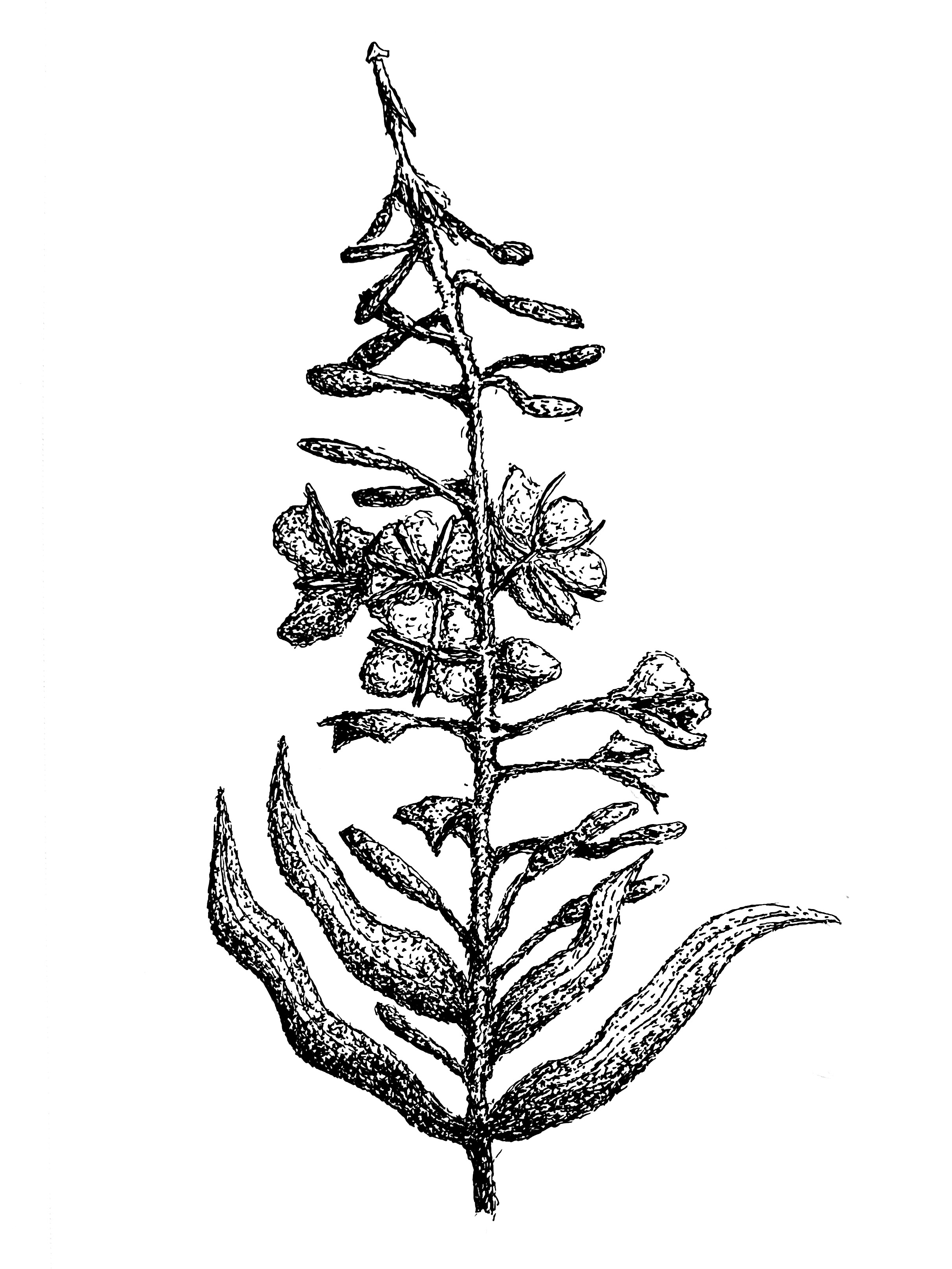
Fireweed is a picturesque magenta plant that is named after its tendency to grow in areas that have recently been burned by fire. Its scientific name is Epilobium angustifolium, and it is a member of the Evening Primrose family, previously classified under the Epilobium (willowherb) genus but currently under the Chamerion group[1]. There are twelve native firewood species in Canada[2]. The plant has many uses for Indigenous communities across North America, most related to its medicinal properties: it can be made into a salve to heal burns; the leaves are dried as a tea for indigestion and intestinal parasites; and the root is crushed and used to draw out infection; or the nectar can be used as a multipurpose glue[3].
Notably, fireweed spread rapidly following the bombing of London during World War II, as well as the eruption of Mount St. Helens in 1980 [1]. Succeeding an event of great devastation of the land, with its adaptable nature and ability to grow in both alkaline and acidic soil environments, fireweed preps the soil for new poplar and willow. With each plant capable of producing 45,000 seeds, fireweed is a markedly resilient specimen that can quickly carpet decimated areas with beauty and vigor.
While driving along the 97 highway through northern British Columbia, the fireweed blanketed the surrounding skeletal remains of a forest past. I was witnessing a grand gesture of healing from the earth to itself. A sight to behold, I was prompted to reflect on my narrow scope of the world. Why do I, and humanity, feel so oppressed by fire? Why do we feel so oppressed by the circumstances we create for ourselves?
After a week on the road, I returned to civilization, turning on my cellular data after three months of radio silence. Once again, I was bombarded by digital media filled with catastrophizing language and trepidating imagery. Sucked back into doomscrolling, a familiar anxiety flooded my consciousness: that humanity is doomed with no recourse. In the midst of feverishly flipping through my camera roll and yearning to return to a time of naivety, I began to see the forest for the trees – that my climate anxiety was being fed by my feed.
Glancing at the photos in my cameraroll, I was reminded of the fireweed and snapped myself out of a comatose state. It was in that moment that I recognized how easily we have become passive participants in our collective demise. Climate denialism from the past has evolved into climate nihilism – a plague on younger generations and victims of the internet.
The doom and gloom tone present in popular media is a control tactic of capitalism. Capitalism aims to foster a separation between our understanding of our own humanness, and our relationship to the planet and the environment. In separating ourselves from the natural world, we isolate ourselves from life itself, lose our joy in living, and our autonomy over how we perceive being alive.
By instilling constant fear in simply existing in the world, we become passive consumers. We lose our desire to steward the land, eventually losing our sense of humanity. As a treeplanter, I cannot control which of the seedlings I planted will survive, but in the act of land stewardship, I gain insight into being human – insight into myself as a cog in the machine of the universe.
We have much to learn from the symbiotic relationship of fireweed and fire. It is paradoxical: the flower can heal once the fire destroys. Everything that exists is both profoundly fragile and immensely resilient. We have to confront death and destruction in order to understand life. Like the fireweed, nature will rebuild itself. When the forest falls, it will rise again. To reclaim our humanness we need to combat capitalism and reclaim our desire to see things grow; to see things change. I hold onto hope that we can find our humanity in curiosity, and joy in our humanity.
So what will be left when the fire stops burning? The answer can only be found through holding onto our desire to know.
Sources
1 U.S. Forest Service. Forest Service Shield. https://www.fs.usda.gov/wildflowers/plant-of-the-week/chamerion_angustifolium.shtml
2 Fireweed | the Canadian encyclopedia. https://thecanadianencyclopedia.ca/en/article/fireweed
3 Rogers, R. Fireweed — a treasured medicine of the Boreal Forest. Discovery Phytomedicine – Journal of Natural Products Research and Ethnopharmacology. https://phytomedicine.ejournals.ca/index.php/phytomedicine/article/view/16

Leave a Reply