
When I was a child, I dreaded stopping for groceries. There was a gnawing nothingness that emerged inside me as I sat in the car hearing my mom ask if we could make a quick stop to grab some choy for the night.
I think it was a feeling that we were doing nothing at this place that took hold of me as we parked the car. The stagnancy amplified within me, reaching my legs, suffocating my walk. I walked as a prisoner behind my mother through the aisle, thinking, I could be doing something way better than this.
I can’t remember when that changed and I began to become intrigued by grocery shopping.
In university, I saw the store as a repository of hidden value, value that could be unearthed through observation and will.
Only fools buy pre-cut fruit (twelve dollars a tray). Don’t they know they can buy a whole cantaloupe for three dollars? Here I stood, phone out in the dairy aisle, comparing gram per dollar yogurt ratio.
It became a contest, or more like a night out at the casino. Can you beat the house? You can if you go to the right supermarket (not Shoppers Drug Mart for produce) and you take it seriously. You have to realize the beast you are up against (Big Grocery) and search for the weaknesses (like “Naturally Imperfect” apples).
Anxiety filled me as items rung up. I glared at the cash register, student card in hand for the discount. Shortly after, if things went well, I walked out through the double sliding doors into the parking lot, headphones in, reusable bags dangling off my body filled with loot, with nothing in my heart but the euphoria of commercial triumph.
Then, as I started to learn to make different dishes, I began to see, with new eyes, produce as possibility. After work, I would stop in to the local supermarket and my mood would soar as I saw, for the first time, ingredients. Looking up at the sauce shelf, I started to imagine entire dishes; I looked up recipes as I shopped; I called my mother in the aisle: “What was that Hong Kong style curry you brought home once?”
Sometimes, walking the aisles after work, the supermarket transformed into a place of marvel. I lost time, imagining the worlds made possible in combinations of novel formulations of rice, assorted cuts of meat, every discovered spice, and hot sauce.
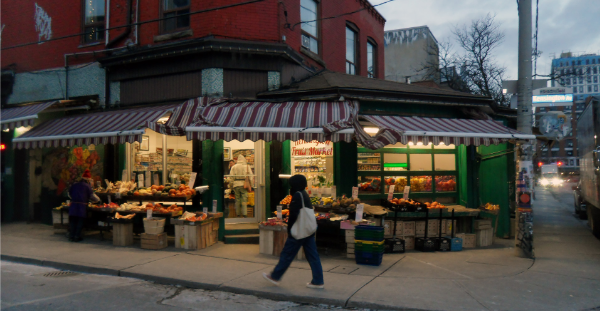
Now, something new has entered my life. From where I live, there is a grocery store on the corner that I think I may come to love. It’s a small store that only sells fruits and vegetables, and, strangely, eggs, in a medium-sized fridge in the corner. It’s around 200 square feet with three sections: the fire-sale area outside the entrance, with buckets of popular fruit; a side area with more neglected offerings; and an indoor U-shaped walkway with chilled vegetables, herbs, and the medium-fridge.
The night I signed my lease, I came here on a celebratory fruit purchase, and I found out the cashiers speak Cantonese, which I also do, somewhat. Summoning bravery, I spoke with my assigned cashier for a minute or two as I checked out, a kind and unpretentious middle-aged woman, who assured me they were the cheapest store around—even more than the Big Stores.
It takes about five minutes for me to walk to the store from my home. When I enter the store, my gaze is on the baskets right in front of me. I dodge other customers who form a single line, bumping elbows as we survey what else we can grab to reach the ten-dollar minimum debit limit. In the line, an older man observes that I am a “fan of fruit”. There is no pop music overhead — just snippets of chatter among staff, asking about breaks and who has eaten dinner already. I feel rude wearing my headphones at the register. As I walk in this small room, filled modestly with yellow light under a low ceiling that features some kind of rectangular metal venting system, my mind is fixed not on planning the possibilities of the week ahead, but on tonight, and what I need for dinner.
The more I return here, the less I feel that old sense of victory. I don’t mind it, though. I’m becoming a regular. Now, I recognize the other players at the table, and they’re sitting too close to me, and the dealer can guess my hand, but I like it. It feels vivid.
On a rainy, frigid fall evening, around 6pm, it is emptier than usual and I enter, a little bit nervous. I hesitate in the narrow aisle, between cabbage and carrot, glancing back along an even narrower aisle. I see a man, in his mid-sixties maybe, sitting on the floor in front of a large metal pot. Inside, there is a large bone, a chunk of cartilage on one end, with pieces of melon floating on the surface. I ask to speak to someone and a woman with shoulder-length hair, round glasses, and a bright smile appears. She agrees to answer my questions. She reminds me of an old family friend.
Her name is Amy and she’s the manager. She’s been working there for 20 years but the store opened 10 years before that as a family business. Now, there’s ten employees.
I ask whether she likes working here. She laughs, thinks, and says, “It’s ok.” I think it must be if she’s been doing it for that long. When the store is busy, it’s good, she says. Six days a week she’s there from nine in the morning to eight-thirty at night.
It’s a business of “essentials,” she tells me. Not everyone can have fancy clothes or jewellery, but everyone needs food.
What I really want to ask is what meaning she gets from the store. Is there something special in this?
“It’s about caring for the neighbourhood,” she says, “and it’s about talking to people.” People come back and tell her what kind of groceries they need—what varieties of fruit to source and what needs to be organic. Because the workers eat from the same groceries, she can tell them what’s good—what pears are especially in this year. She smiles; she feels good about that. Where I live, there are many stores like this one. But this one might become special to me. It’s just food—but it’s essential, and the essentials are all I need sometimes. After I let Amy go, I check out my basket of produce. There’s no line. On the way out, I get complimented in Cantonese by one of the cashiers . “He’s a young journalist,” she tells her co-worker. I smile, try to deny it, and walk down the street back home.


Leave a Reply