

“The future is made up of fragments of the past, and these fragments are the working tools to invent the future”
Erwin Panofsky
“I view worldliness as something critical to the question of how we overcome the exhaustion of the contemporary. If we are to be serious about what it means to be inhabitants of a wandering star—an errant planet with an eccentric orbit—the paths we must follow are those that take us back to the sense of what it means to be planetary. To be contemporary with the prehistoric and the forms of life that are yet to come”.
Shuddhabrata Sengupta
Will our future truly consist of fragments of the past? Topics such as ecological sustainability and social justice can be uniquely future-oriented in their aims and methods. Furthermore, they can be focused on the construction of a future that is built through reactions which affirm or negate a perceived historical trajectory. This task is complex, as the past does not possess an objectively defined form to be recovered and exhumed in the present. The past is constructed and reconstructed through every retelling, as the subjectivities of the storyteller and their context offer new vantage points and textures to familiar themes and rhythms. If our future will be built using fragments of the past, will we either do so unconsciously and reflexively, intentionally through rigorous processes of reflection and analysis, or in some combination thereof?
Our present moment in this city has been shaped by a framework of anti-Indigenous policies and rhetoric, which pushes for the absolute eradication of Indigeneity. This involves boxing away Indigenous peoples and their practices to a “pre-historic” past disconnected from and fundamentally incompatible with the “historical progress” of the settler-colonial nation-state. In this framework, Indigeneity has no place in our “present.” It is seen as a hostile and empty domain of knowledge and being which prevents the emergence of the “future.” In other words, the goal of this systemic erasure is a scenario in which there are no viable fragments to be drawn from Indigenous historical experiences, to be used as tools to invent our future.
A powerful form of resistance to this false “historical” narrative is storytelling. By sharing generations of lived experience, we can honour longstanding relationships with the land along with the practices we develop to sustain those connections through time. Among the most poignant Indigenous stories is that of the Three Sisters, who collaborate to overcome cosmic challenges and to help each other to grow and thrive. Herein lies a narrative we must engage with not as a fragment of the past, so as to not participate in colonial erasure, but as a moment transcending notions of temporality.
Specifically, the Three Sisters represent maize, squash, and beans. They are crops that Indigenous communities grew together in a shared space, which allows them to nourish the soil and protect each other. The cornstalks provide a structure for the beanstalks to wind around. The beanstalks nourish the soil with nitrogen as they develop, and their vines help to reinforce the cornstalk against heavy winds. The leaves of the squash help preserve moisture and discourage weed growth by shading the soil, while their prickliness deters curious and hungry animals. This companion planting method has been observed to produce the highest average yield of all crops involved. This rich symbiotic relationship is beautifully embodied in Indigenous stories across the various regions of Turtle Island, in the symbolic form of the story of the Three Sisters. The details of the narrative may shift according to the specific community telling the story, but the themes of symbiosis and cooperation remain as core elements.
Like the story of the Three Sisters, I urge the reader to reflect on a childhood story that inspired and fascinated you. When you analyse this story through your current lens, shaped by all of the experiences that brought you to this moment, and lay this story against the thoughts and feelings it elicited during your childhood, what emerges: Do these parts of yourself engage in a dialogue that produces a harmony or a dissonance that pushes you to imagine further? The power of a story is realised once it generates this kind of self-reflection, in bringing all versions of yourself into the present moment in conversation with one another.
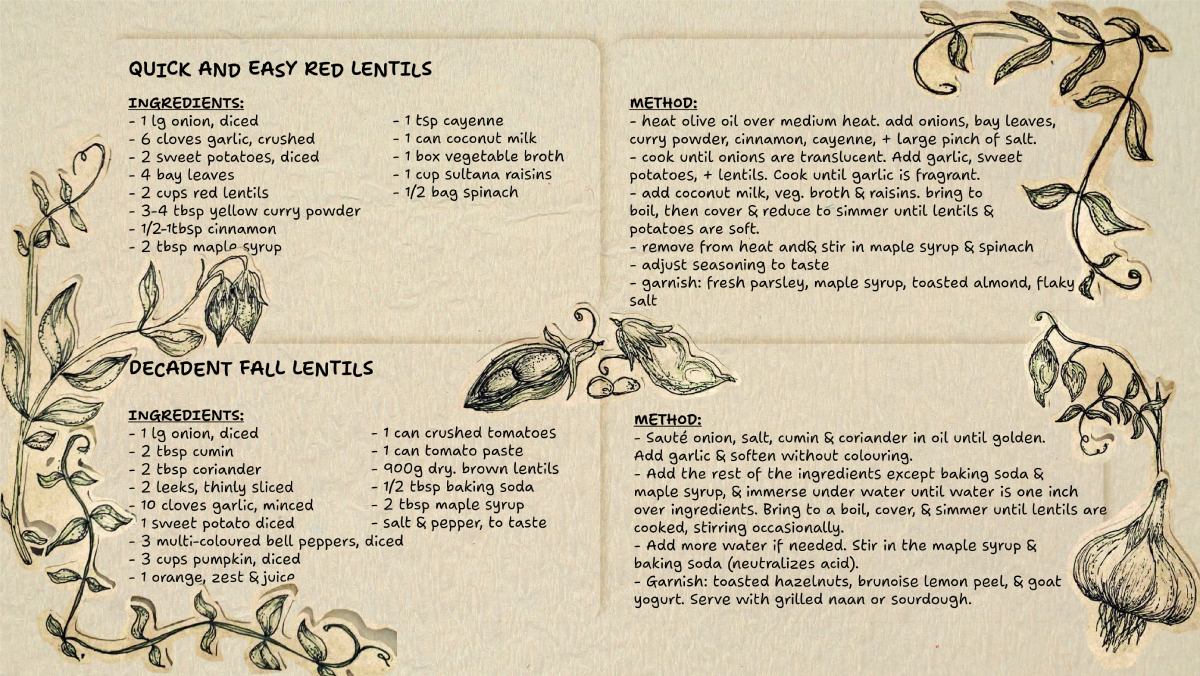
The overlapping stories of the Three Sisters are a repository of knowledge concerning foodways. Foodways are a constellation of cultural, social, and economic practices surrounding food, emerging from all stages of its cultivation. Such a model captures the richness of human life in relation to the land, and in a way that accounts for the diverse relationships that create and sustain the natural world outside of human purview. Through this lens, food and the land from which it is cultivated becomes far more than a resource to be exploited for human benefit.
The many stories of the Three Sisters imbues a personhood to nature, honouring the various relationships which sustain the ecosystem. They offer an ethics of reciprocation, where food and the management of land is seen as something done in collaboration rather than something done by a subject onto an object. Opening up a process like agriculture, which can seem dry and mechanical, to the realm of imagination offers a powerful opportunity to rethink the tenets of the world around you that you may take for granted.
With the ongoing climate injustice that is unmaking the world as we know it, I take great solace in thinking about the creative potential in the erosion of systems and ways of thinking that have brought us to our present moment. I encourage you to look more into the many stories featuring the Three Sisters, and to use them as a springboard to imagine a better world that brings with it all of the wisdom and love that sustains us in the present. Think about the folklores that play a role in shaping how you see the world, and allow them to continue to make and to remake you.

Leave a Reply